

What is Lifestyle Medicine?
My bachelor’s degree is in engineering, and I like to think in graphs. This graph helps me frame the discussion regarding Lifestyle Medicine:
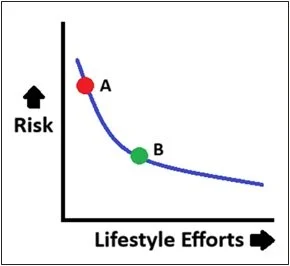
In a nutshell, Lifestyle Medicine guides people towards healthier habits to decrease their long-term risk. On the graph above, this could mean helping people get from point A to B. Lifestyle Medicine breaks down habits into 6 Pillars, as follows:
1. Nutrition
2. Physical Activity
3. Sleep
4. Stress Management
5. Social Connections
6. Avoidance of Risky Substances
What does Point A look like? I would describe this as a “Path of Least Resistance”, built on habits that can be the easiest to follow (or simply hard to avoid) that generally involve pursuing short-term pleasure and avoiding inconvenience. Many of the habits here are addictive, and many large companies profit from intentionally feeding these unhealthy habits. Applying the 6 Pillars, this looks like the following:
1. Eating too much (or too little) and not the right things
2. Not getting enough exercise
3. Sleeping too little or too much
4. Having unhealthy or underdeveloped coping skills
5. Substituting unhealthy social habits such as “doom-scrolling” social media for meaningful social connection
6. Over-consuming risky substances.
How does Lifestyle Medicine address this? First and foremost, humility is essential. Judgment is a deal-breaker. We are all human and make mistakes. Practicing lifestyle medicine requires building trust and partnership along the journey.
Referring back to my previous article, what is the prognosis of staying at point A? The short-term risks are low, but the long-term risks are high. It can take years or decades for serious health consequences to show up, such as diabetes or heart disease. Guiding people from Point A to B is a process that can take years, but transformational change is possible.
People often ask me about the value of Direct Primary Care if they only see the doctor once a year for a wellness visit or if they don’t see a doctor at all. In these yearly visits, traditional primary care does a good job of screening for serious health problems that are often consequences of spending too much time at Point A, but these visits are generally ineffective for helping people prevent these problems from happening in the first place. Direct Primary Care allows more time to practice Lifestyle Medicine and help guide people towards the path of healthier habits to move from Point A to Point B.
This article will serve as a foundation to build on for future posts. Stay tuned!
